
Experimental Data for Chromatography Modeling
A mechanistic model is only as good as the data it is calibrated against. This page covers the main experiment types used in chromatography modeling, what each one tells you, and how to get the most out of your experimental effort.
Types of Experiments
Different experiments provide information about different parts of the model. In general, the data you collect falls into two categories:
- Non-binding experiments (pulse injections) are used to characterize column transport and system dead volume, independent of the molecules you want to separate.
- Binding experiments (breakthrough curves, step elutions, gradient elutions) are used to calibrate adsorption isotherm parameters that describe how molecules interact with the stationary phase.
The sections below describe each experiment type in more detail.
Pulse Injections
A pulse injection is the simplest experiment in chromatography modeling. A small volume of tracer solution is injected into the column and the resulting peak is recorded at the outlet.
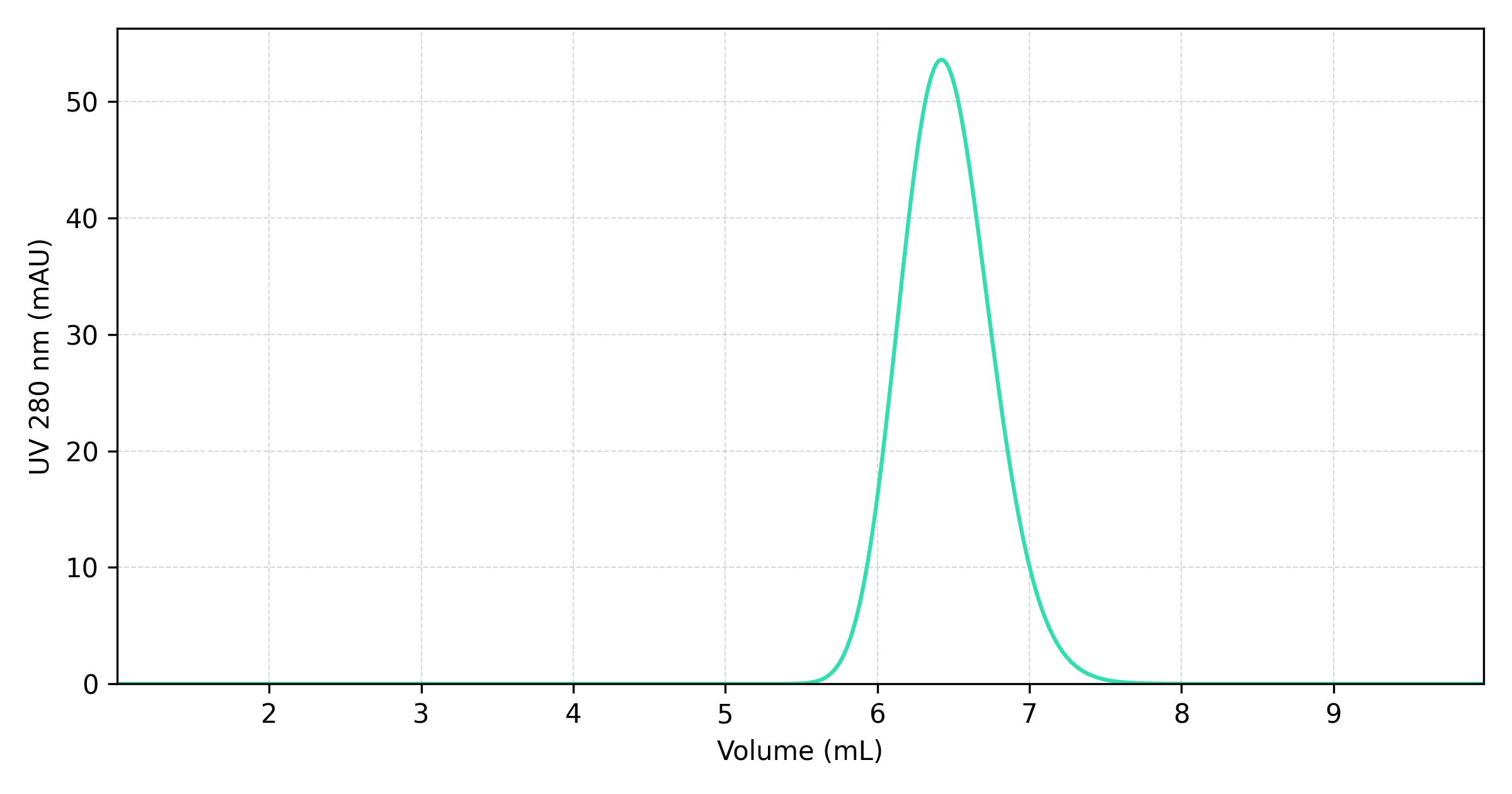
Pulse injections are used to determine:
- Column porosity calculated from the retention time of the tracer. A non-binding, non-excluded tracer (e.g. acetone or NaCl) measures total porosity, while a fully excluded tracer (e.g. Blue Dextran) measures interstitial porosity.
- Axial dispersion calculated from the width and shape of the outlet peak. A broader peak indicates more dispersion.
- System dead volume calculated by running a pulse injection without a column (or through a zero-dead-volume connector), you can isolate the contribution of tubing, mixers, and detectors.
Breakthrough Curves
In a breakthrough experiment, the column is continuously loaded with a feed solution at a fixed concentration until the column is saturated and the feed concentration appears at the outlet. The resulting S-shaped curve provides direct information about binding capacity and mass transfer kinetics.
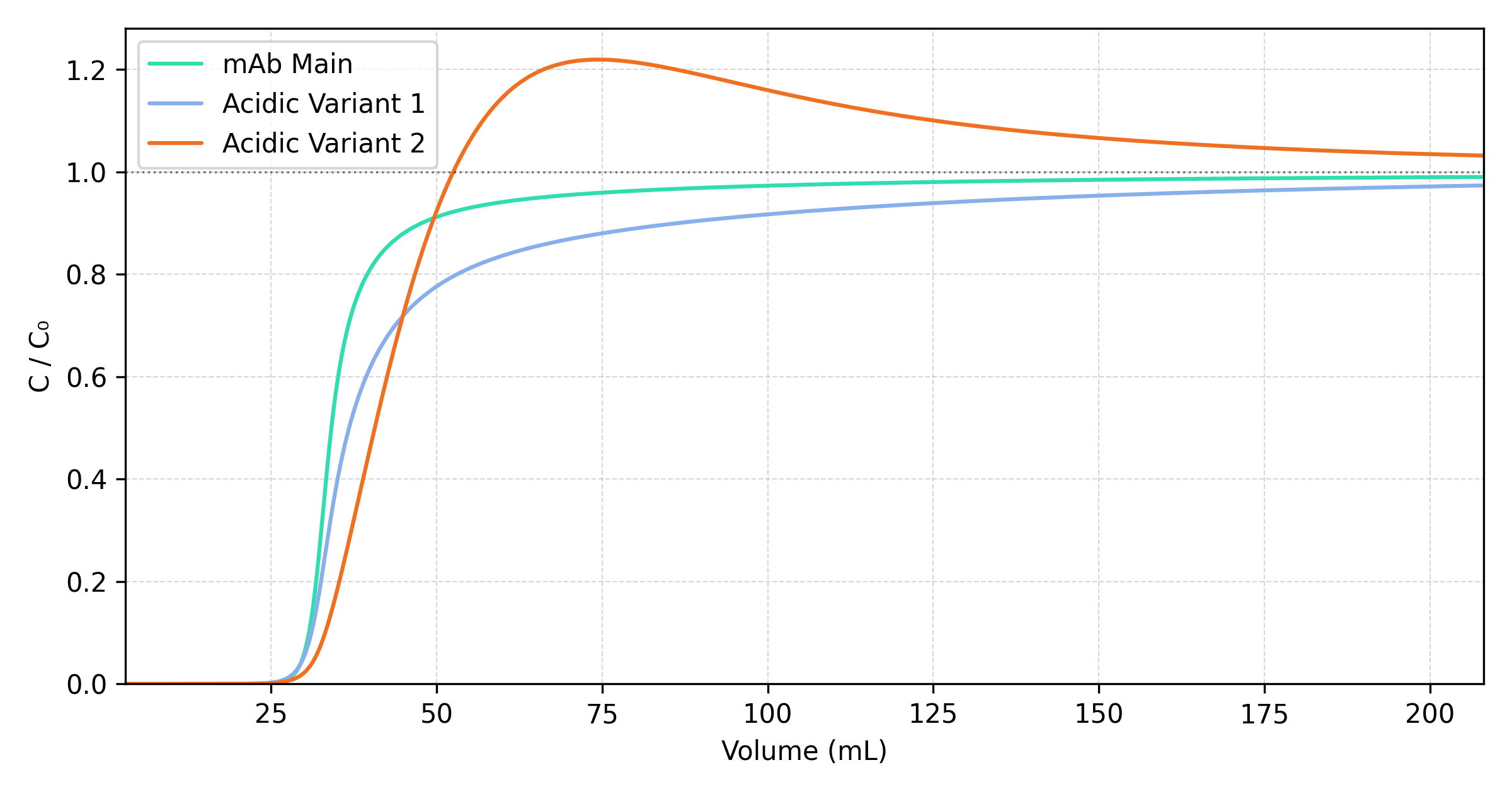
Breakthrough curves are particularly useful for:
- Maximum binding capacity. The total amount of protein bound at saturation, directly related to the isotherm's capacity parameter.
- Mass transfer kinetics. The steepness of the breakthrough front reflects how quickly molecules diffuse into the particle pores and bind to the surface. A sharper front indicates faster mass transfer.
- Multi-component competition. When loading a mixture, breakthrough curves reveal displacement effects where a stronger-binding species pushes out a weaker one, producing an overshoot in the weaker component's outlet concentration.
Breakthrough experiments at different feed concentrations or flow rates are valuable for calibrating binding models, especially when the isotherm has nonlinear behavior at higher loading.
Gradient and Step Elutions
Gradient and step elutions are the most common experiment type in preparative chromatography. Molecules are first loaded onto the column under binding conditions, then eluted by changing the mobile phase composition, either gradually (gradient) or abruptly (step).
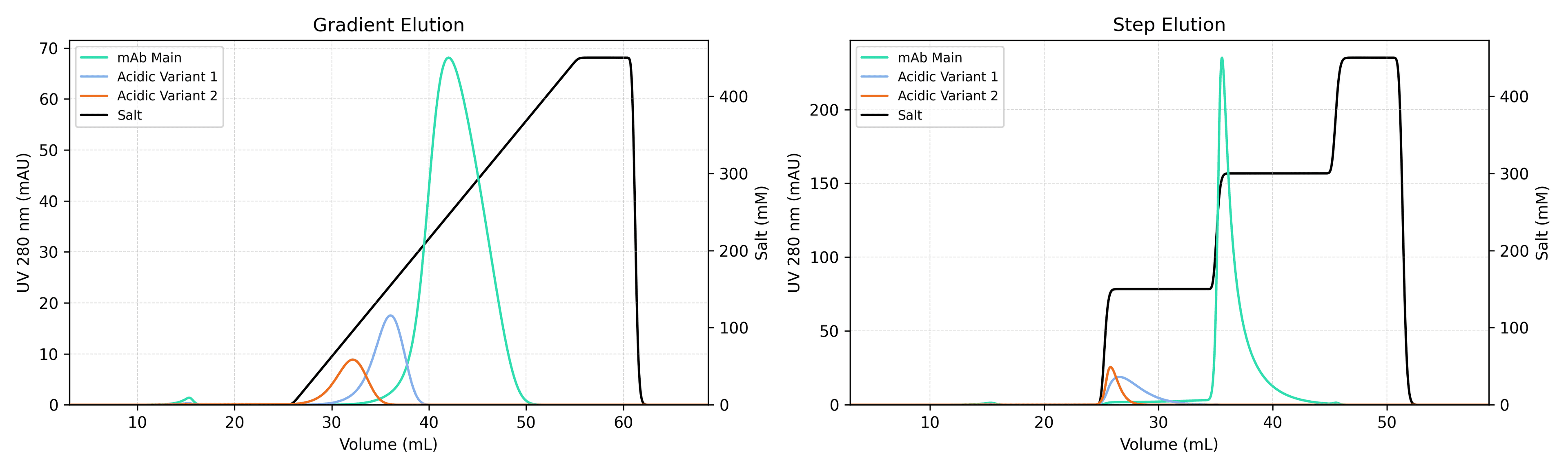
From a modeling perspective, elution experiments provide:
- Retention behavior. Where peaks elute as a function of modifier concentration, which constrains equilibrium binding constants.
- Peak shape and resolution. Peak width and asymmetry provide information about kinetic effects, mass transfer, and binding heterogeneity.
- Selectivity. The relative elution order and separation between components under different gradient conditions.
Running elutions at different gradient slopes or step heights gives the model information about how binding strength varies with modifier concentration. This is critical for calibrating salt-dependent or pH-dependent binding models used in ion exchange and hydrophobic interaction chromatography.
Data Quality Considerations
The quality of your experimental data directly affects the reliability of the calibrated model. A few common issues to watch for:
- Baseline drift: A drifting UV baseline can distort peak areas and shapes. Subtract or correct the baseline before importing data.
- Signal saturation: If the UV detector saturates at high concentrations, the peak tops are clipped and the model will underestimate binding capacity. Dilute the sample or use a shorter path length cell if this occurs.
- Flow rate accuracy: Small deviations in actual vs. set flow rate shift retention times and can lead to systematic errors in fitted parameters. Verify your pump calibration, especially at low flow rates.
- Temperature control: Binding equilibria and diffusion coefficients are temperature-dependent. Ensure consistent temperature across experiments.
- Dead volume alignment: When comparing experimental and simulated chromatograms, make sure the system dead volume is modeled correctly. Misaligned dead volumes shift peaks in time and can be mistaken for errors in binding parameters.
Planning an Experimental Campaign
A well-planned experimental campaign minimizes lab time while providing enough data for a reliable model. A typical campaign for a single-column separation looks like this:
- System characterization. 1 pulse injections without a column to measure extra-column dead volume.
- Column characterization. 2 pulse injections with the column using a non-excluded tracer (e.g. acetone or NaCl) and a fully excluded tracer (e.g. Blue Dextran).
- Calibration. 4-8 binding experiments (breakthrough curves or elution runs) at different conditions to calibrate the isotherm.
- Validation. 1-2 additional experiments at conditions not used during calibration to verify the model predicts accurately.
This amounts to roughly 8-13 experiments in total. Compared to a full DoE that might require 20-50+ runs, a model-based approach covers a much larger design space with significantly less experimental effort.