Chromatography Simulator

We provide a simulation platform for downstream process development, optimization, and in-silico screening for all types of biologics.

Key Features

High-Fidelity Modeling

Accurate prediction of chromatography behavior using advanced mechanistic models.

Process Optimization

Optimize operating conditions and reduce experimental burden with in-silico testing.

Scale-Up Confidence

Predict behavior at production scale before investing in expensive pilot runs.

Rapid Development

Accelerate process development timelines with fast, iterative simulations.

Comprehensive Analysis

Detailed insights into column dynamics, breakthrough curves, and pooling strategies.

User-Friendly Interface

Intuitive web-based platform that requires no specialized software installation.

Fully customizable flowsheet

Visualize and edit your chromatography system with an easy to use drag-and-drop system. Save systems between projects, share with team members, or choose between predefined templates.

Mechanistic Modeling Workflow

Ground your models with only a handful of real-world experiments, then simulate thousands of realistic chromatography runs in minutes.
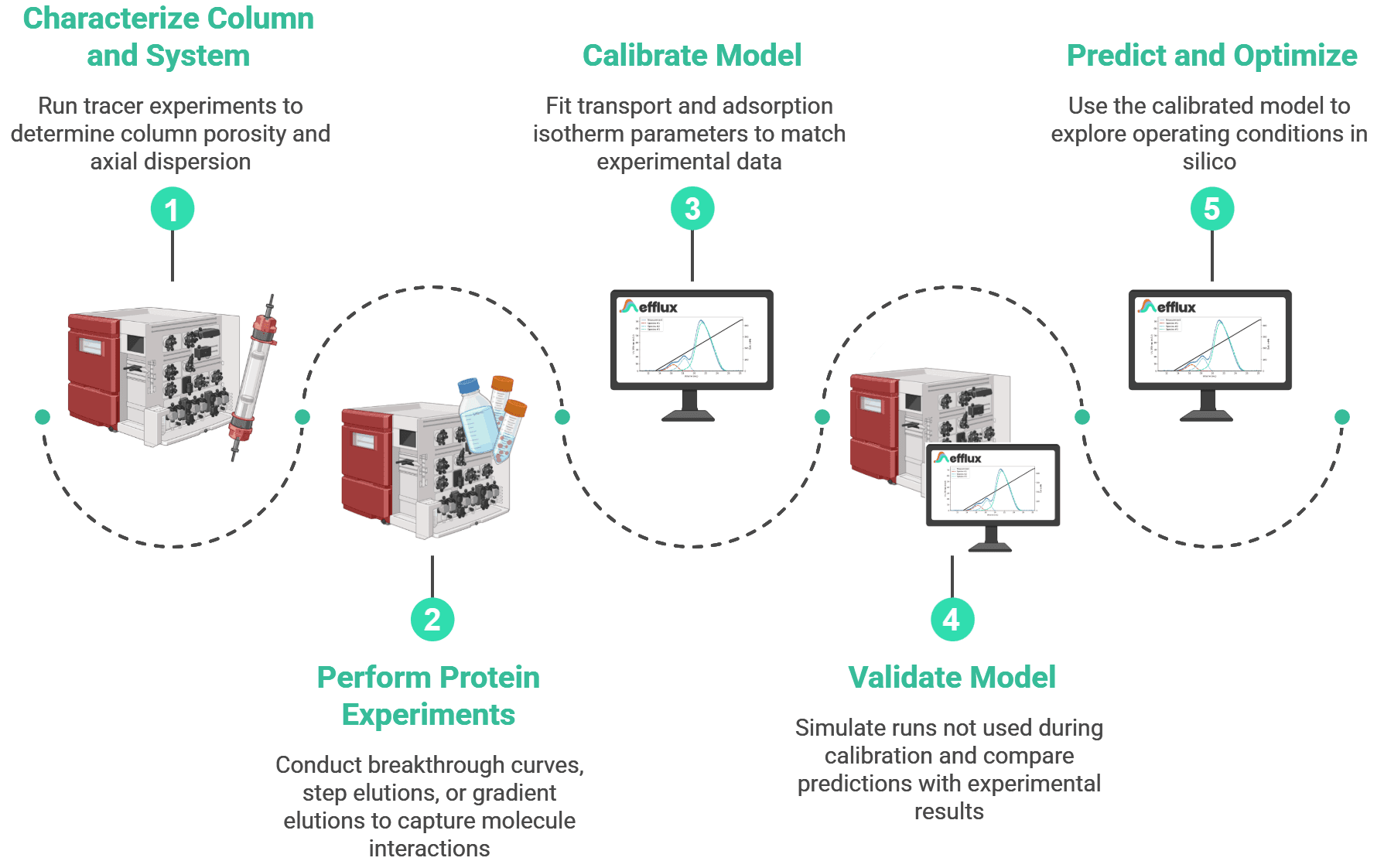
Mechanistic modeling workflow: characterize column and system, perform protein experiments, calibrate model, validate model, predict and optimize

Common Questions

The simulator uses mechanistic models based on physical first-principles equations to simulate chromatography experiments. You define your system using a drag-and-drop flowsheet editor, specify your column, resin, and operating conditions, and the simulator solves the underlying transport and adsorption equations to predict chromatogram outputs. Learn more about mechanistic modeling.
All types of biomolecules are supported, including:
  • Monoclonal antibodies (mAbs)
  • Adeno-associated viruses (AAVs)
  • Nanobodies
  • Fusion proteins
  • Plasmids
  • Oligonucleotides
  • And more
Both bind-elute and flow-through operation modes are supported, including:
  • Ion exchange (IEX)
  • Hydrophobic interaction (HIC)
  • Affinity
  • Size exclusion (SEC)
  • Mixed-mode (MMC)
Each interaction method is described by a specific binding model. Learn more about binding models.
The simulations are based on mechanistic models that describe the underlying physical processes within the column. When calibrated with a small number of experiments, the models can accurately predict chromatography behavior across a wide range of operating conditions, including conditions not tested experimentally.
Yes. One of the key advantages of mechanistic modeling is the ability to predict chromatography behavior at different scales. You can develop and calibrate your model at lab scale and use it to predict performance at pilot or manufacturing scale.
No. Efflux is a fully web-based platform that runs in your browser. There is no software to install or maintain, and you can access your simulations from any device.
Yes. We understand that your data is sensitive. We use state-of-the-art security systems to keep all of your sensitive data secure. Very sensitive data, like protein sequences, are stored encrypted, meaning that even in the unlikely event of data leakage, your sequences remain secure. Learn more about our security practices.

Ready to accelerate your chromatography development?

Join leading biopharma companies using Efflux to simulate downstream process development, scale up, and more.