Buffer System Selection in Downstream Bioprocessing
 Efflux Team6 min read
Buffer selection is one of the earliest decisions in chromatography method development, yet it is often made out of habit rather than deliberate evaluation. The choice of buffer system affects pH stability during scale-up, ionic strength contributions, interaction with the stationary phase, and cost at manufacturing scale. This blog post provides a structured overview of the most common buffer systems used in preparative chromatography and outlines when each one is the right tool for the job.
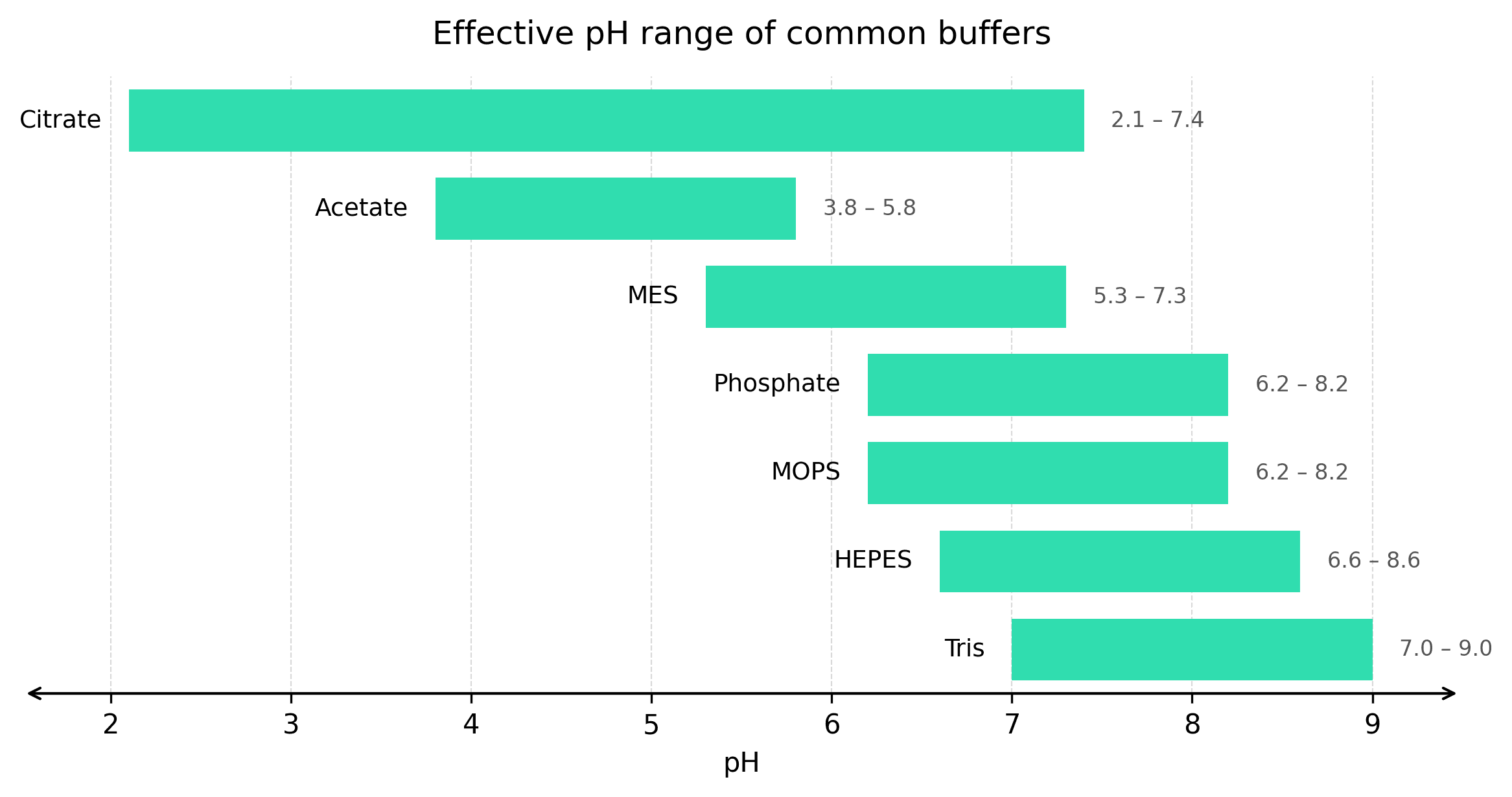
As a starting point, recall that a buffer is effective within approximately pH unit of its . Outside this range, buffering capacity drops rapidly. The table below summarizes the key properties of the most widely used buffer species in downstream processing.
| Buffer | pKa (25 °C) | Effective pH Range | Typical Application |
|---|---|---|---|
| Acetate | 4.76 | 3.8 – 5.8 | ProtA, CEX, HIC |
| Citrate | 3.13 / 4.76 / 6.40 | 2.1 – 7.4 | ProtA, CEX, viral inactivation |
| MES | 6.27 | 5.3 – 7.3 | CEX, AEX |
| Phosphate | 2.15 / 7.20 / 12.35 | 6.2 – 8.2 | ProtA, IEX, SEC, HIC |
| MOPS | 7.18 | 6.2 – 8.2 | SEC, AEX |
| HEPES | 7.57 | 6.6 – 8.6 | SEC |
| Tris | 8.06 | 7.0 – 9.0 | AEX |
Why Buffer Choice Is Important
The buffering capacity of a buffer system is the ability to resist pH changes in a solution. It is at a maximum when the pH equals the of the buffer species, where the acid and conjugate base are present in equal concentrations. As the pH moves away from the , capacity drops off, and beyond roughly pH unit it is effectively negligible. A buffer at the right nominal pH but near the edge of its range will drift easily under process perturbations (feed slugs, salt changes, or temperature shifts).
For example, consider a CEX step targeting pH 5.8. Acetate (pKa 4.76) is a common default for CEX, but at pH 5.8 it is already at the upper edge of its effective range (≈ 1 pH unit above pKa) and the pH may drift during loading. MES (pKa 6.27) is a better fit.
The buffer species also matters beyond pH. Using phosphate on an anion exchange column, for instance, seems reasonable based on its pKa (7.20), but the dibasic form HPO42- carries a -2 charge and can compete with proteins for binding sites. Tris, as an example, avoids this: its free base is neutral and does not interact with the resin, making it, in general, a better choice for AEX processes.
Temperature Sensitivity
The temperature dependence of is often an ignored factor in buffer selection. A buffer prepared at 25 °C may behave very differently at 4 °C in a cold room, or vice versa. The magnitude of this shift depends entirely on the temperature coefficient of the buffer species.
The pH shift when moving from 25 °C to a target temperature can be approximated as
For a Tris buffer prepared at pH 8.0 at 25 °C, this means the effective pH at 4 °C is approximately 8.6. This is a significant shift of more than half a pH unit. On an ion exchange column, this can meaningfully alter selectivity and yield, by changing the effective charges of the proteins involved. In contrast, a phosphate buffer, with a temperature coefficient nearly 12 times smaller, shifts by less than 0.05 pH units over the same range.
| Buffer | dpKa/dT (K-1) | pH shift (25 → 4 °C) | pH shift (25 → 50 °C) |
|---|---|---|---|
| Acetate | +0.0003 | -0.01 (0.2%) | +0.01 (0.2%) |
| Citrate | -0.0004 | +0.01 (0.2%) | -0.01 (0.2%) |
| Phosphate | -0.0024 | +0.05 (0.7%) | -0.06 (0.8%) |
| MES | -0.0087 | +0.18 (2.9%) | -0.22 (3.5%) |
| MOPS | -0.0113 | +0.24 (3.3%) | -0.28 (3.9%) |
| HEPES | -0.0120 | +0.25 (3.3%) | -0.30 (4.0%) |
| Tris | -0.0279 | +0.59 (7.3%) | -0.70 (8.7%) |
This all means that if you prepare buffers at room temperature but run your columns in a cold room (or the other way around), Tris-based methods may need pH re-optimization. Phosphate and acetate, by contrast, behave almost identically across this temperature range. For a more detailed treatment of how temperature and ionic strength affect apparent pKa, see our post on buffer mathematics.
We also provide a free buffer calculator which accounts for temperature effects and will give you the correct recipe for your target temperature when preparing buffer solutions.
Practical Considerations
Citrate is a strong chelator of divalent cations, e.g., Ca2+, Mg2+, Fe2+. This can be beneficial: chelation of trace metals reduces the risk of metal-catalyzed oxidation of methionine and tryptophan residues, which can be a concern during low-pH hold steps. However, for metalloproteins or processes where divalent cations are functionally important, citrate can strip essential cofactors and compromise product activity.
Phosphate presents a different compatibility issue: it forms insoluble salts with Ca2+ and Mg2+. This is particularly relevant when phosphate buffers are used in systems where CaCl2 or MgCl2 are present as additives. Precipitation can clog frits, foul columns, and produce misleading UV signals. If your process includes divalent cation additives, consider switching to a non-interacting buffer like acetate, HEPES or MOPS.
It is also worth noting that not all buffers contribute equally to ionic strength at the same molar concentration. Phosphate and citrate are polyprotic and carry multiple charges at physiological pH, meaning they contribute more ionic strength per mole than monovalent buffers like Tris or acetate. This matters for ion exchange chromatography, where the ionic strength of the mobile phase directly affects binding capacity and selectivity. A 50 mM phosphate buffer at pH 7.2 has a meaningfully higher ionic strength than a 50 mM Tris buffer at pH 8.0, even though both are at the same nominal concentration.
Finally, most common buffers are transparent at 280 nm, the standard monitoring wavelength for proteins. However, if you are working at lower wavelengths — 214 nm for peptide bond detection, for instance — organic acid buffers like acetate and citrate absorb significantly below 230 nm and will interfere. Tris and phosphate remain transparent across the typical UV range.
A Decision Framework
Choosing a buffer ultimately comes down to a few sequential questions. The chromatography mode and target pH narrow the field; practical constraints then determine the final selection.
- What is the target pH? This eliminates any buffer whose effective range does not cover it. A buffer at the edge of its range will require higher concentrations to maintain adequate buffering capacity.
- Will temperature vary between development and manufacturing? If yes, favor buffers with low temperature coefficients (phosphate, acetate, citrate) over temperature-sensitive ones (Tris, HEPES, MOPS).
- Are divalent cations present? If your process uses Ca2+ or Mg2+ additives, avoid phosphate (precipitation) and consider the chelation effects of citrate.
- Are you monitoring at low UV wavelengths? Organic buffers absorb UV light below 230 nm. If you rely on 214 nm detection, stick to inorganic buffers like Tris or phosphate instead.
- Is cost a factor at scale? At manufacturing volumes (hundreds of liters of buffer), acetate and phosphate salts are commodity chemicals and significantly cheaper than buffers like MES, HEPES, and MOPS.
Conclusion
The buffer system is a process parameter that impacts robustness, selectivity, and scalability, and deserves similar attention during process development as resin selection, column selection, and elution mode. The default buffer system selection exist for good reasons (acetate for CEX, Tris for AEX, phosphate for most neutral-pH applications), but understanding why they work helps you recognize when they do not.
From a regulatory and manufacturing perspective, phosphate, acetate, and citrate have the longest track record in approved biopharmaceutical processes and are well-established in pharmacopeial monographs. When in doubt, the simpler and better-documented buffer system is usually the easier path through CMC.
For precise buffer recipe calculations that account for temperature and ionic strength effects, try our buffer calculator. For the underlying thermodynamics, see our post on buffer mathematics. And if you want to simulate how buffer choice affects your chromatographic separation, give Efflux a try.
Want to know more?
Efflux provides chromatography modeling and simulation software and services to leading biopharma companies.